Quantum Computing in Data Science and STEM Education
A Bibliometric and Pedagogical Analysis with Strategic Implications





1 📂 Data preparation and harmonisation
1.1 Analytical scope
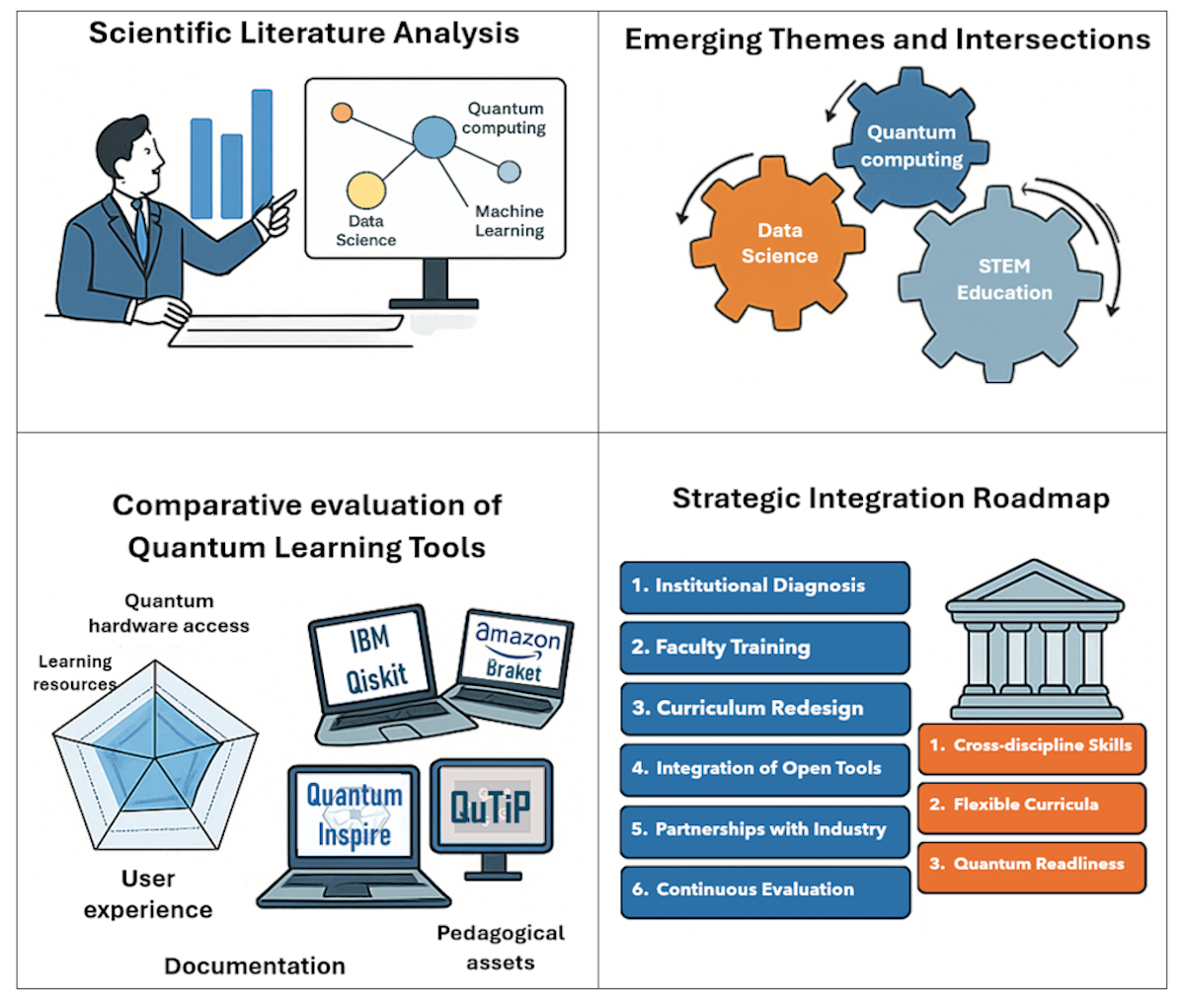
This notebook documents the analytical groundwork supporting the study of quantum computing in data science and STEM education. Rather than reproducing the full narrative of the associated article, it exposes selected methodological decisions and exploratory steps that underpin the broader analysis.
The focus is placed on data preparation, harmonisation, and analytical structuring, which are essential to ensure that subsequent bibliometric and pedagogical analyses are both reproducible and methodologically coherent.
1.2 Data source and scope
The analysis relies on bibliographic metadata extracted from the Scopus database, covering peer-reviewed publications published between 2015 and 2024 at the intersection of quantum computing, data science, and education.
Only metadata fields relevant to bibliometric analysis are considered, including: - publication year, - authorship and affiliations, - keywords and abstracts, - document type and subject areas.
Full-text content is not processed, and no proprietary datasets are redistributed.
1.3 Harmonisation strategy
Bibliographic data are inherently heterogeneous, reflecting differences in indexing practices, author-provided keywords, and institutional naming conventions. To address these challenges, a conservative harmonisation strategy is adopted:
- Metadata are loaded from curated export files.
- Duplicates are identified and removed using explicit matching criteria.
- Keywords are normalised to reduce lexical variation.
- Records lacking minimal analytical completeness are excluded.
- No manual editing is performed.
This approach ensures that analytical structures emerge from the data rather than from ad hoc adjustments.
 # 🔍 Exploratory bibliometric structures
1.4 Analytical intent
This stage provides an exploratory view of the bibliographic landscape underpinning the study. The objective is not to exhaustively report results, but to expose the structural patterns that motivate later analytical and interpretative choices.
Exploration is deliberately selective, focusing on: - thematic organisation of the field, - temporal signals of consolidation or emergence, - and the balance between technological and educational contributions.
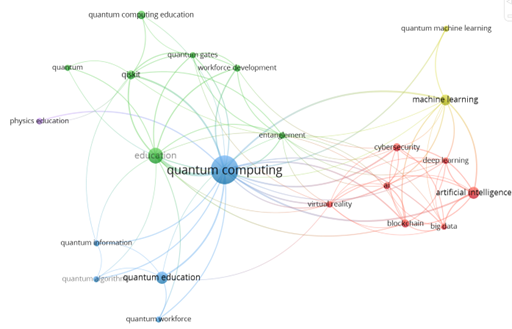
1.5 Keyword co-occurrence structure
Keyword co-occurrence analysis offers a compact representation of how concepts are articulated across the literature. By examining recurrent keyword associations, it becomes possible to identify dominant thematic cores and peripheral or emerging topics.
The resulting structure reveals a strong concentration around core technological concepts, while education-oriented and pedagogical themes appear as connected but secondary clusters. This configuration motivates the subsequent focus on translation into educational practice, rather than purely technical advancement.
1.6 Temporal orientation of the field
An exploratory inspection of publication years provides additional context for interpreting thematic patterns. Rather than presenting detailed growth curves, the emphasis here is on identifying phases of acceleration and diversification in the literature.
The temporal signal supports the interpretation of quantum education as a recently consolidating domain, with increasing interest after 2020 and growing intersections with data science and AI-related topics.
1.7 Methodological note
All exploratory views presented in this section are intended to inform analytical direction, not to serve as standalone results. Detailed quantitative outputs and complete visualisations are reported in the associated article.
2 🎓 Pedagogical tools: analytical criteria
2.1 Analytical intent
This section outlines the analytical logic and criteria used to examine selected quantum computing platforms from a pedagogical perspective. The aim is not to rank tools or to provide exhaustive technical comparisons, but to clarify how educational suitability is assessed within the study.
By making these criteria explicit, the notebook documents the reasoning that underpins the comparative analysis presented in the associated article.
2.2 Selection logic
Platforms were selected based on their documented presence in higher education contexts and their relevance to introductory or intermediate quantum education. Both institutional and academic initiatives were considered in order to capture diverse implementation models.
The analysis focuses on representative examples, rather than attempting to provide a comprehensive catalogue of available tools.
2.3 Pedagogical evaluation criteria
The evaluation framework is structured around four main dimensions:
Accessibility
Availability of open or educational access, ease of onboarding, and infrastructure requirements.Usability
Clarity of interfaces, quality of documentation, and alignment with common teaching environments.Educational resources
Presence of tutorials, guided examples, and curriculum-oriented materials.Curricular alignment
Suitability for integration into existing STEM programmes and data science curricula.
These dimensions reflect pedagogical considerations rather than technical performance metrics.
2.4 Interpretative stance
The resulting assessments are interpreted qualitatively and contextually. No claims of pedagogical superiority are made, and no attempt is made to prescribe specific platforms.
Instead, the analysis highlights patterns of alignment and mismatch between platform design and educational needs, supporting informed decision-making at institutional and curricular levels.
2.5 Methodological note
Detailed comparative results and visual summaries are reported in the associated article. The purpose of this notebook section is to document the analytical framework, not to replicate published findings.
3 🧭 Methodological reflections and limitations
This notebook adopts a deliberately selective and methodological perspective. Its purpose is not to reproduce the full set of empirical results reported in the associated article, but to expose key analytical decisions and boundary conditions that shape the study.
Several limitations are therefore explicit:
- The analysis relies exclusively on bibliographic metadata, not on full-text content.
- Bibliometric structures are sensitive to indexing practices and keyword choices.
- Pedagogical evaluations are based on documented use and design characteristics, not on controlled educational experiments.
- The selection of tools prioritises representativeness over exhaustiveness.
These limitations are not treated as shortcomings, but as methodological constraints that preserve analytical clarity and reproducibility. They also delineate clear avenues for future work, including deeper qualitative studies and applied educational evaluations.
By making these constraints explicit, the notebook supports a transparent and reflexive research stance, aligned with the broader objectives of the doctoral research programme.
4 🌐 Repository and citation
All materials associated with this notebook—including figures, rendered outputs, and configuration files—are available in the public repository:
https://github.com/jcaceres-academic/quantum-computing-stem-education
For the complete scientific context, results, and discussion, readers are referred to the associated peer-reviewed article:
Cáceres-Tello, J.; López-Meneses, E.; Galán-Hernández, J. J.; López-Catalán, L. (2025). Quantum Computing in Data Science and STEM Education: Mapping Academic Trends and Analyzing Practical Tools. Computers, 14, 235. https://doi.org/10.3390/computers14060235
This notebook is provided as a methodological companion to the article, supporting transparency, reproducibility, and reuse within related research contexts.
5 📚 References
All cited works are managed through the shared bibliographic file
A public mirror of this bibliography is archived in the author’s Zotero collection:
➡️ https://www.zotero.org/groups/6375391/computers-2025